
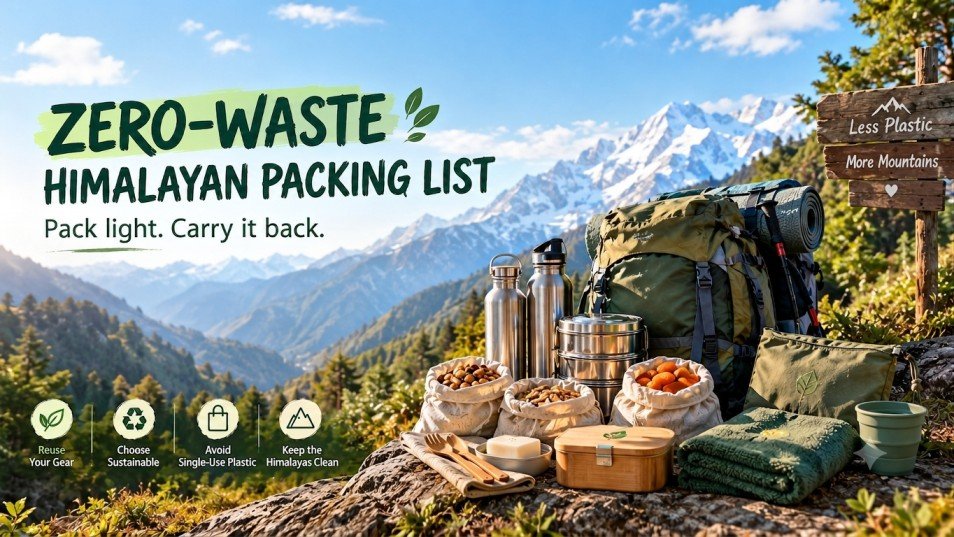
The Zero-Waste Himalayan Packing List That Actually Leaves Nothing Behind
Most trek packing lists tell you what to carry up. Almost none tell you what comes back down. Here is the honest version, written for Garhwal trails and built around what the mountains can actually handle.
Here is a number worth carrying up the hill with you.
In 2024, volunteers with The Himalayan Cleanup, a waste and brand audit run since 2018 by Zero Waste Himalaya and the Integrated Mountain Initiative, collected 1,21,739 pieces of litter across the Indian Himalayan Region. Of those, 1,06,857 were plastic. More than 80 percent of that plastic came from single-use food and beverage packaging. And roughly 70 percent of it was non-recyclable.
Read that last part again. Not “was not recycled.” Could not be. There is no facility, no buyer, no scrap dealer, and no market value for a multilayered chips wrapper at 3,000 metres.
This is the thing that ordinary packing lists get wrong. Down in the city, waste is something that disappears when you are not looking. On a Himalayan trail, there is no disappearing. What you carry up either comes back down in your bag, or it stays. It stays in a stream that feeds a village. It stays in the stomach of a Himalayan black bear. It stays for the next forty years.
So this is an eco-friendly travel packing list written backwards. Instead of starting with what you need, it starts with what the mountain will be left holding.
What Zero Waste Actually Means on a Trek
Let us be honest about the phrase first, because it gets thrown around loosely.
Zero waste trekking does not mean you generate nothing. That is not possible and anyone promising it is selling something. What it means is far simpler and far more achievable: nothing you carry up the mountain stays on the mountain.
Every item in your bag should pass three tests before it goes in:
- Can I refill or reuse this? If it is designed to be thrown away after one use, it fails.
- Am I willing to carry it back down dirty? If the honest answer is no, you will litter it. Leave it at home.
- If I dropped this on the trail, would it still be here in ten years? If yes, it needs a very good reason to come along.
That is the whole framework. Everything below is just application.
The Zero-Waste Himalayan Packing List
Use this as an eco-friendly travel packing list you can adapt to any Garhwal or Kumaon trail, from a two-day walk to Deoriatal to a week on the Rudranath route.
Water: the single easiest win
Packaged drinking water is the most common piece of waste on Uttarakhand trails, and the most avoidable.
- Two one-litre steel or copper bottles. Steel survives being dropped on rock. Plastic reusables crack in cold.
- A water filter or purification method. A squeeze filter, chlorine dioxide drops, or a UV pen. Himalayan streams look clean and frequently are not, especially below grazing meadows or villages.
- An insulated flask for the tea your homestay host will insist on packing.
One honest note on the rules here. India’s single-use plastic ban does not cover packaged water bottles, so you can still buy them legally. On the Char Dham routes, Uttarakhand runs a Digital Deposit Refund System where bottles and multilayered packets carry a QR code and a refundable deposit of ten rupees, returnable at collection points and at reverse vending machines at Gaurikund and Kedarnath. According to the Press Information Bureau, that system has recycled over 20 lakh bottles and created more than 110 jobs.
It works well. But it only works where there is a return point. On a remote trek to Rudranath or Kuari Pass, there is no counter to hand your bottle back to. Refill is the only real answer.
Food and snacks: where 80 percent of the problem lives
If you fix nothing else on this list, fix this one. Food packaging is the single largest category of Himalayan trail litter by a wide margin.
Carry:
- A steel tiffin and a steel or bamboo spork. Plastic cutlery, plates, cups and straws have been banned nationwide since 1 July 2022 under the Plastic Waste Management Amendment Rules, 2021, as confirmed by the Ministry of Environment, Forest and Climate Change.
- Loose bulk snacks in cloth bags. Roasted chana, gur, walnuts, dried apricots, sattu, and mandua or jhangora-based local snacks. Buy them by weight from a shop in Ukhimath or Joshimath, not in packets from a city supermarket.
- A cloth bag for fruit and roti.
Leave behind: chips packets, energy drink bottles, instant noodle packs, tetra packs, sachet condiments, and biscuit wrappers. These are exactly the items that make up the non-recyclable majority of mountain waste.
There is a second benefit here that nobody mentions. Buying loose snacks in a hill town puts money into a village shop instead of a distribution chain. That is the same economic logic behind choosing a genuine local homestay over a corporate property, which we covered in detail in our guide on how to identify a genuinely eco-friendly homestay versus greenwashing.
Washing and personal care
Sachets are the quiet villain of this category. They are small, cheap, and completely unrecyclable.
- Solid soap bar and solid shampoo bar in a small tin
- Bamboo or neem toothbrush, tooth powder or tablets in a tin
- A small quick-dry towel
- Sunscreen and lip balm in metal tins or glass, not sachets
- A steel or bamboo comb
Skip wet wipes entirely. They are plastic fabric, they do not break down, and they are one of the most commonly littered items on Indian trails.
When you wash, follow the Leave No Trace principle on waste disposal: carry water at least 60 metres away from any stream or lake, use a small amount of biodegradable soap, and scatter the used water. Biodegradable does not mean stream-safe. It means soil-safe.
Toilet and menstrual care
This is the section most packing lists politely skip. It should not be skipped.
- A lightweight trowel. Where there is no toilet, dig a cathole 15 to 20 centimetres deep (6 to 8 inches), at least 60 metres from water, camp and trail. Cover and disguise it when done.
- A dedicated waste pouch for toilet paper. Leave No Trace allows either burying toilet paper deep in the cathole or packing it out. Above the treeline, packing it out is the better call, because decomposition at altitude is extremely slow and shallow-buried paper gets dug up by animals. Burning it is not an option.
- A menstrual cup or reusable cloth pads. If you use disposables, carry a sealable pouch and pack them out. There is no acceptable alternative, and burying or burning them is not one.
- Hand sanitiser in a refillable bottle.
Clothing and gear
The most sustainable gear on any trek is the gear that already exists.
- Borrow or rent big-ticket items like sleeping bags, down jackets and trekking poles rather than buying new for one trip.
- Repair before you replace. A patched jacket outperforms a new one you bought guiltily.
- Layer with wool and synthetics, avoid cotton. Wet cotton at altitude is a genuine safety risk, not just discomfort.
- A headlamp with rechargeable batteries plus a power bank, rather than a pile of disposable cells. Used batteries are hazardous waste and there is nowhere in a Garhwali village to dispose of them safely.
The pack-it-out kit
This is the part almost nobody packs, and it is the part that turns intention into action.
- Two or three dry bags or thick cloth bags for waste, one for wet
- A small tin or sealed pouch for cigarette butts if you smoke, because butts are plastic
- A pair of light gloves
- Optional but powerful: weigh your waste bag at the end. It changes how you pack next time.
What to Leave at Home
| Leave behind | Carry instead |
|---|---|
| Plastic cutlery, plates, cups, straws (already banned) | Steel spork and tiffin |
| Packaged water in bulk | Refillable steel bottle plus filter |
| Wet wipes | Small towel and soap bar |
| Shampoo and condiment sachets | Solid bars and refillable tins |
| Chips, noodle and biscuit packets | Loose snacks in cloth bags |
| Disposable rain ponchos | Proper rain jacket, borrowed if needed |
| Disposable batteries | Rechargeables plus power bank |
| Bluetooth speakers | Silence, and the birds you came to hear |
The Night-Before Repackaging Ritual
This takes twenty minutes and removes more waste than any gear purchase.
The Leave No Trace framework puts repackaging food to cut down on waste under its very first principle, Plan Ahead and Prepare. It is the highest-leverage thing on this entire list.
- Empty every packaged item onto a table.
- Move the contents into cloth bags, steel tins and reusable containers.
- Dispose of all the packaging at home, where a functioning waste system exists.
- Decant toiletries into small refillable tins.
- Do a final pass: pick up each item and ask, “am I willing to carry this back down dirty?”
Whatever fails that last question comes out of the bag.
The Rules You Should Actually Know Before You Walk
A few things are not optional, and knowing them saves you trouble at a check post.
- Single-use plastic ban. Since 1 July 2022, the manufacture, sale, and use of identified single-use plastic items, including cutlery, plates, cups, straws, stirrers, and thermocol decoration is prohibited across India.
- Protected area rules. The Valley of Flowers and Nanda Devi National Parks are a UNESCO World Heritage Site. Single-use plastic is prohibited inside, overnight stays are not permitted in the Valley, and entry permits are issued by the Uttarakhand Forest Department. Verify current fees, timings, and registration requirements before you travel, as they change by season.
- Registration. For Char Dham routes and many regulated treks, register through the official Tourist Care Uttarakhand portal.
- Pack it in, pack it out. This is not a suggestion. Burning waste in a campfire is not disposal, and dumping downhill puts it in someone’s water.
How Ecorahi Fits Into This
Gear only gets you part of the way. The bigger variable is who you walk with and where you sleep.
A local trek leader from these valleys already knows which streams are safe to refill from, where the collection points are, and which campsites have been damaged by careless groups. That knowledge is worth more than any item on this list.
The same is true of where you stay. A genuine eco homestay will refill your bottle, feed you food grown within walking distance, and separate its waste properly. A property that hands you a packaged water bottle at check-in has told you something important about the rest of its operation.
Every listing on Ecorahi is a local family, guide, trek leader or driver from Uttarakhand. You book with them directly on WhatsApp and we take no payment and no commission. Browse all listings or open the map to find hosts along your route.
Pack light. Carry it back. Leave the mountain the way the people who live there need it to stay.
Ecorahi Team, Uttarakhand
Frequently Asked Questions
What should be on a zero waste trekking packing list?
The essentials are a refillable steel bottle with a water filter, a steel tiffin and spork, loose snacks in cloth bags, solid soap and shampoo bars, a menstrual cup or reusable pads, a trowel for catholes, and dedicated waste bags to pack everything out. The single biggest change is repackaging all food before you leave home.
Is plastic banned on Himalayan treks in India?
Identified single-use plastic items including cutlery, plates, cups, straws and stirrers have been banned across India since 1 July 2022. Packaged water bottles are not covered by that ban, but many protected areas including Valley of Flowers National Park prohibit single-use plastic entirely, and Uttarakhand runs a deposit refund system on Char Dham routes.
Why is plastic waste worse in the mountains than in cities?
Because there is no collection system to absorb it. Around 70 percent of plastic collected in Himalayan waste audits is non-recyclable multilayered packaging with no market value, so waste pickers and scrap dealers will not collect it. It ends up in streams, on hillsides and in wildlife.
What is the best water purification method for Himalayan treks?
A squeeze filter, chlorine dioxide drops or a UV purification pen all work well and remove the need for packaged water. Carry a backup method, since filters can clog and electronics can fail in cold.
How do I deal with toilet waste responsibly on a trek?
Use toilets where they exist. Where they do not, dig a cathole 15 to 20 centimetres deep at least 60 metres from water, camp and trail, and cover it fully. Leave No Trace allows toilet paper to be buried deep in the cathole or packed out, but at Himalayan altitudes packing it out is safer because decomposition is very slow. Sanitary products should always be sealed in a pouch and carried out. Never burn either.

Leave a Review
There are no reviews yet. Be the first one to write one.