
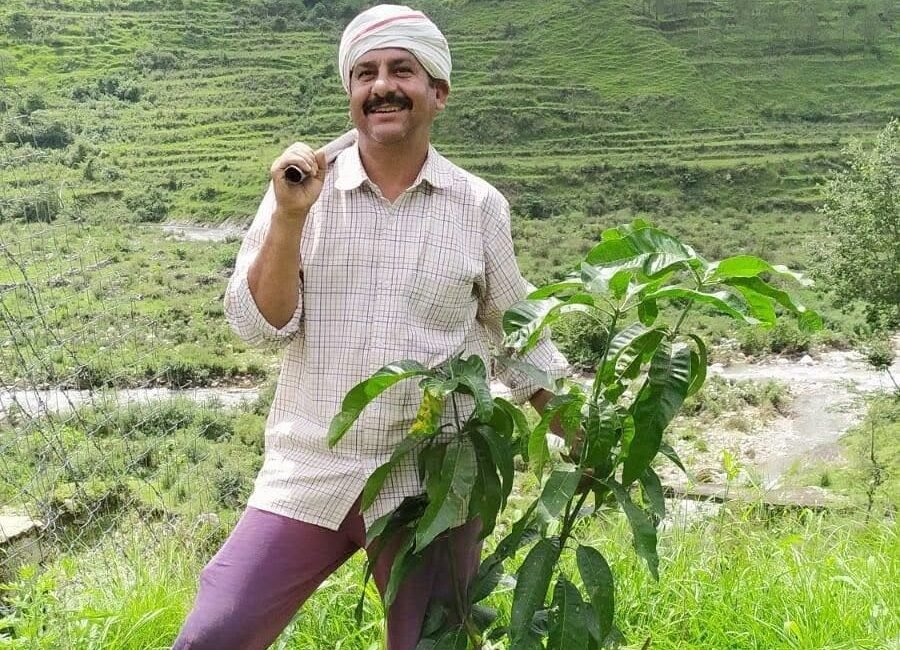
Sudheer Sundriyal and Feel Good: How Farming Is Creating New Opportunities in Rural Uttarakhand
A ground-level story of hill agriculture, community participation and the search for sustainable rural livelihoods
When people leave Uttarakhand’s villages for work or education, fields can be left uncultivated and local knowledge can fade. Returning is not simple either. Families must consider income, children’s education, healthcare, transport and the realities of hill farming.
Sudhir Kumar Sundriyal, also searched as Sudheer Sundriyal, returned to his ancestral village of Dabra in Pokhra block, Pauri Garhwal, in 2014. In January 2015, he established the Feel Good Charitable Trust. Its work has included sharing planting material and farming knowledge, helping farmers access small equipment, supporting water conservation and raising funds for children’s education. The larger aim is to strengthen village livelihoods so that moving away for lack of local opportunities is not the only option.
From a media career in Delhi to a return to Dabra
Sundriyal spent about two decades in the National Capital Region working in media. In an interview, he said he had spent 18 years in Delhi, including a final decade with India TV. He has described missing his village and worrying about the condition of his ancestral home and fields.
The independent Down To Earth profile says that after returning in 2014, he visited agricultural institutions in Uttarakhand to learn about suitable farming and horticulture. That learning phase is important: slope, sunlight, altitude, soil, water and field access all influence what can be grown in the hills.
He established the Feel Good Charitable Trust in January 2015 to extend this work beyond his own fields. In interviews, he describes bringing together people who want to help their villages even if they cannot all return permanently. They may contribute money, technical advice, seeds, plants, equipment or voluntary labour. The phrase “Bhal Lagat Feel Good” expresses this community-minded approach.
A farm model that shares produce, plants and knowledge
Sundriyal uses his own farm as a demonstration site. According to Down To Earth’s 2022 profile, he sorts the harvest twice a year. One batch of fruits, vegetables, pulses, wheat and paddy is kept for household use. A second batch, including apples, lemons, walnuts and cardamom, along with seeds and saplings worth an estimated Rs 1.5 lakh to Rs 2 lakh, is distributed free to farmers in Dabra and nearby villages.
Down To Earth reported that more than 100 farmers were part of the Feel Good Agro Developers group. While sharing plants and seeds, Sundriyal also gives practical cultivation advice. The report quotes farmer Shailesh Pokhriyal of Gehunlad saying Sundriyal gave him “300 lemons for sowing”. Pokhriyal said around 100 plants were producing fruit and that he had harvested 20 to 25 kilograms that year. This is one farmer’s experience, not a yield promise for other farms.
The Trust has also helped farmers borrow small equipment through a machinery bank, with financial support from the Uttaranchal Association of North America and Save Indian Farmers, as reported by Down To Earth. Shared equipment can help reduce costs where individual plots are small and scattered.
Diversifying crops to suit the mountain landscape
In a farm-walk video featuring Sundriyal and related interviews, he describes trials with pulses, malta, lemon, galgal, kiwi, peach, plum, apple ber, grapes and large cardamom, among other fruit trees. These are reported plantings and experiments, not a verified list of crops that all generate commercial income today.
His advice is to assess each field before choosing a crop. Slope, altitude, sunlight, soil, moisture, water supply and road access can differ even within one village. Farmers should test varieties suited to their own plots and seek advice from local horticulture or agriculture experts before investing at scale.
Sundriyal also describes combining vegetables, pulses and orchards. Shorter-cycle crops may provide earlier produce while fruit trees take longer to mature. This can spread the timing of household food and income, although crop calendars and returns vary with local conditions.
Collective farming and the problem of scattered land
Scattered plots make farming costly and difficult. Fencing, irrigation, moving tools and organising labour take more time when a household’s fields are spread across different locations.
Sundriyal has advocated collective cultivation and written land-use agreements. Nearby landowners could allow a farmer or group to cultivate their plots under agreed terms covering the period of use, maintenance, fencing, expenses and division of produce. This is an approach he has proposed, not a claim that it is already operating as a formal programme across the region.
Written consent matters. Informal permission can lead to disputes if a landowner changes their mind, crops are damaged or compensation is linked to the land record rather than the person cultivating it. Any agreement should protect both sides and follow applicable local rules.
Water conservation is part of the farming system
Seasonal water shortages can limit vegetable cultivation and the survival of orchards. Water conservation is therefore part of any serious effort to bring unused farmland back into production.
Down To Earth reports that Feel Good helped build irrigation reservoirs and supported farmers’ water-conservation campaigns. In interviews, Sundriyal also describes residents, students and people living outside Uttarakhand contributing labour or financial support to water-harvesting work. Community participation can help people understand why these structures matter and encourage their upkeep.
What migration data says about the challenge
The Uttarakhand Rural Development and Migration Commission’s April 2018 migration report recorded 3,570 people in the semi-permanent migration category across 57 gram panchayats in Pokhra block, and 2,036 in the permanent migration category across 49 gram panchayats during the preceding ten-year period. These are historical survey figures, not current population counts, and the categories follow the Commission’s own definitions.
For Pokhra, the report lists livelihood and employment difficulties as the most common recorded reason for migration (42.84 per cent), followed by lack of education facilities (16.80 per cent) and healthcare facilities (16.49 per cent). It also records crop damage by wild animals (6.80 per cent) and low agricultural productivity (6.58 per cent). The data show why farming support matters, but also why families need education, healthcare, transport and other services.
The Commission’s August 2025 interim reverse-migration report recorded 6,282 people who had returned to their original village or a nearby rural area and restarted a livelihood by August 2025. Pauri Garhwal had 1,213 recorded returnees, the highest district total.
A separate update reported in September 2026, citing Uttarakhand tourism officials, put the number of people who had returned to their native villages since 2020 at around 6,500. The same report said approximately 1,500 had established homestays under the Deendayal Upadhyay Home Stay Development Scheme. This is a separate tourism-department estimate, so it should not be treated as a directly comparable revision of the Commission’s August 2025 survey count. Read the September 2026 report on return migration and homestays.
| Indicator | Reported figure | Context |
| Returnees across Uttarakhand | 6,282 | Recorded by the Commission up to August 2025 |
| Returnees in Pauri Garhwal | 1,213 | Highest district total in the report |
| Agriculture and horticulture | 2,440 (38.8%) | Share of recorded returnees by livelihood category |
| Tourism and services | 1,348 (21.5%) | Share of recorded returnees by livelihood category |
| Livestock-related business | 1,134 (18.1%) | Share of recorded returnees by livelihood category |
The Commission describes these as preliminary return-migration figures. They show that people are trying different livelihood options, but they do not prove that out-migration has stopped or that return migration has become larger than migration out of the state.
Horticulture has potential, but markets and support matter
Horticulture is economically significant in Uttarakhand. NABARD’s 2025-26 State Focus Paper, citing the state’s Economic Survey 2024-25, reports around 1.73 lakh hectares under horticulture and annual production above 11.26 lakh metric tonnes. The sector supports nearly 4.5 lakh farmers, about 88 per cent of them small and marginal, and contributes more than Rs 3,350 crore to the rural economy.
The NABARD State Focus Paper also identifies barriers such as fragmented holdings, access to quality planting material, inadequate post-harvest facilities and weak market infrastructure. Farmers need buyers, storage, transport, grading and value addition, not only higher production.
Organic claims need equal care. APEDA’s 2024-25 NPOP data lists 56,009.91 hectares of organic area and 38,414.86 hectares under conversion in Uttarakhand. These are state-level certification figures; they do not establish that Sundriyal’s farm is certified organic. The interviews and independent profile support describing his work as diversified agriculture and horticulture, not as certified organic farming. See APEDA’s NPOP certification data for the distinction between organic and in-conversion land.
Lessons for people thinking about returning to a village
Sundriyal advises people considering a return to have savings or another income source that can support them for around four to five years while they test crops and wait for horticulture to mature. This is his practical advice, not a guarantee that every farm will become profitable within that period. Practical steps include:
- Assess land, water, sunlight, access and wildlife risks before choosing crops.
- Start small, test varieties and record costs, labour, yields and selling prices.
- Combine suitable short-cycle crops with longer-term horticulture.
- Use clear written agreements when cultivating someone else’s land.
- Identify buyers, transport, storage and processing before expanding production.
- Include women in decisions and ensure tools and training reduce drudgery rather than adding unpaid work.
Beyond farming: education, community and culture
Beyond farming, Down To Earth reports that Sundriyal and his wife, Hemalatha, help raise funds for the education of 60 children in Pauri district. The report also describes the Trust’s machinery bank and water-conservation work. These activities reflect a wider view of rural development: families need educational opportunities as well as ways to earn.
Sundriyal also mentions supporting women’s Dhol-Damau groups and Mangal singing teams. These cultural activities are described in interviews and should be confirmed directly before stating their current scale or status.
Where Ecorahi’s vision connects
This story connects with Ecorahi’s aim to make local livelihoods and community-based experiences easier to discover. Farms can share local food and crop traditions with visitors, homestays can source ingredients from nearby growers, and local guides and taxi providers can help visitors explore villages while keeping more spending within the community.
Through its directory of local Uttarakhand providers and sustainable travel experiences, Ecorahi helps travellers discover homestays, agro-farms, guides, cabs and other local services. It cannot replace agricultural support or public infrastructure, but it can improve the visibility of local providers and help travellers connect directly with them.
Conclusion: make village life a workable choice
Sudhir Kumar Sundriyal’s work in Dabra does not prove that one organisation can reverse migration across Uttarakhand. It shows how local initiative can contribute: demonstrate farming practices, share planting material, connect farmers, improve equipment access, conserve water and support education.
Villages need more than appeals asking people to return. They need reliable livelihoods, essential services, fair markets and opportunities for women and young people. Farming can be part of that future when it is suited to local conditions and connected to buyers and community needs.
For Ecorahi, the message is clear: make local skills, farming and village-based services visible, and help travellers connect directly with the people who sustain rural communities. Returning to Uttarakhand should be a realistic and dignified choice, not only a matter of nostalgia.
Frequently asked questions
Who is Sudhir Kumar Sundriyal?
He is a former media professional who returned to Dabra village in Pauri Garhwal in 2014 and established the Feel Good Charitable Trust in January 2015.
What does Feel Good Charitable Trust do?
Down To Earth reports that it shares saplings, supports a machinery bank, works on water conservation and helps raise funds for children’s education.
Which crops are part of Sundriyal’s farming experiments?
His farm-walk video and interviews mention pulses, citrus, kiwi, peach, plum, apple ber, grapes and large cardamom. These are reported plantings and trials, not guaranteed commercial crops.
Is his farm certified organic?
The sources reviewed do not verify certification for Sundriyal’s farm. The article therefore describes his work as diversified hill agriculture and horticulture, not certified organic farming.
Can farming alone stop migration?
No. Farming can strengthen local income, but education, healthcare, transport, market access and other services also influence whether families can remain in villages.
Leave a Review
There are no reviews yet. Be the first one to write one.